




Precision in Brief: Five Studies Advancing Precision Medicine and the Evidence We Still Need
From CRISPR gene editing and personalized cancer vaccines to artificial intelligence, multi-omics, and women’s health.
Medicine is entering an extraordinary period of scientific advancement.
We can now edit genes directly within the human body, develop cancer vaccines around the molecular characteristics of an individual tumor, use artificial intelligence to interpret physiological signals, and analyze biological changes across entire populations.
These developments are expanding what may become possible in clinical medicine.
But an important distinction remains: scientific innovation is not synonymous with clinical validation.
A promising biological mechanism does not necessarily translate into improved patient outcomes. An immune response does not establish that a cancer treatment prolongs survival. A predictive algorithm does not automatically improve clinical decisions. And a large observational dataset, regardless of its sophistication, cannot independently establish causation.
At The Pursuit of Precision, we believe that advancing medicine requires examining both the potential of emerging discoveries and the quality of evidence supporting them.
This week’s Precision in Brief examines five important areas of research, what the findings demonstrate, their limitations, and the additional scientific evidence needed to bring these developments closer to meaningful clinical application.
01 | CRISPR Gene Editing in Hereditary Angioedema
Research focus: In vivo genome editing
Journal: The New England Journal of Medicine
Study: Lonvoguran Ziclumeran — In Vivo CRISPR Gene Editing in Hereditary Angioedema
Evidence level: Randomized Phase 3 clinical trial
The Science
Hereditary angioedema (HAE) is a rare genetic disorder characterized by recurrent episodes of swelling that may affect the skin, gastrointestinal tract, and airway. Attacks can be unpredictable, debilitating, and potentially life-threatening.
Although existing treatments can effectively prevent or manage attacks, many require ongoing administration.
Researchers investigated lonvoguran ziclumeran, an investigational CRISPR-based therapy designed to reduce production of plasma kallikrein, a protein involved in the biological pathway responsible for HAE attacks.
The treatment uses in vivo gene editing, meaning the genetic modification occurs within the patient’s body rather than in cells removed and manipulated outside the body.
The goal is to produce a sustained therapeutic effect following a single administration.
What the Evidence Shows
The randomized Phase 3 trial reported a substantial reduction in HAE attack frequency compared with placebo.
The findings provide evidence that targeting a defined molecular pathway through gene editing can produce clinically meaningful disease control.
Unlike early laboratory or animal studies, this investigation evaluated outcomes directly relevant to patients: the frequency of symptomatic attacks.
This distinction is important because the study demonstrated more than biological target engagement. It provided randomized clinical evidence of therapeutic benefit.
What Remains Uncertain
Although the results are promising, the duration of follow-up remains limited relative to the potentially lifelong consequences of gene editing.
Questions remain regarding long-term durability, unintended genomic alterations, delayed adverse events, and how the therapy compares with established preventive treatments.
What We Need to See Next
To strengthen the evidence and support broader clinical confidence, we would like to see:
Long-term safety and durability: Five- to ten-year follow-up evaluating sustained attack reduction, delayed adverse events, and potential unintended effects of gene editing.
Independent replication: Additional clinical investigations across diverse populations and treatment centers.
Comparative effectiveness: Direct comparisons with established HAE prophylactic therapies, including quality-of-life outcomes and treatment burden.
Genomic safety surveillance: Continued assessment of off-target editing and other unintended genomic consequences using appropriately validated methods.
Real-world evidence: Longitudinal registries evaluating outcomes outside controlled clinical trial environments.
Why It Matters
This research represents an important shift in therapeutic strategy.
Rather than repeatedly administering treatment to suppress symptoms, gene editing may allow us to intervene directly in a molecular pathway responsible for disease.
However, the standard for clinical adoption must remain rigorous.
A durable biological modification requires equally durable evidence of safety and clinical benefit.
02 | Personalized Cancer Vaccines in Ovarian Cancer
Research focus: Personalized immunotherapy and tumor neoantigens
Journal: Nature Medicine
Study: Personalized neoantigen-targeting cancer vaccines in ovarian cancer
Evidence level: Phase 1 clinical trial
The Science
Cancer is not a uniform disease.
Even among patients diagnosed with the same cancer type, tumors can differ significantly in their genetic mutations, molecular signaling pathways, immune environments, and responses to treatment.
Personalized cancer vaccines attempt to exploit these differences.
Researchers identify mutations within an individual’s tumor and use that information to develop vaccines targeting tumor-specific neoantigens.
Neoantigens are abnormal protein fragments that may be recognized by the immune system as foreign.
By presenting selected neoantigens to the immune system, researchers hope to stimulate a targeted antitumor immune response.
A Phase 1 study in ovarian cancer investigated this strategy in combination with PD-1 immune checkpoint blockade.
What the Evidence Shows
Researchers reported tumor-specific immune responses following vaccination.
The findings support the biological feasibility of developing individualized immunotherapies based on the molecular characteristics of a patient’s cancer.
The study also contributed early information regarding tolerability and the practicality of manufacturing patient-specific vaccines.
However, the study was primarily designed to investigate feasibility, safety, and immunological activity.
It was not designed to definitively establish improvements in survival.
What Remains Uncertain
An immune response is not equivalent to clinical efficacy.
Although vaccine-induced T-cell responses may demonstrate successful immune activation, they do not independently establish that treatment reduces recurrence, delays progression, or extends survival.
Tumor heterogeneity and immune escape also present significant challenges.
What We Need to See Next
Randomized Phase 2 and Phase 3 trials: Controlled investigations comparing personalized vaccine strategies with appropriate standard-of-care regimens.
Clinically meaningful endpoints: Progression-free survival, overall survival, durable response, and patient-reported quality of life.
Predictive biomarker validation: Identification of tumor characteristics, immune signatures, and genomic features associated with treatment response.
Longitudinal tumor monitoring: Evaluation of tumor evolution, antigen loss, and mechanisms of immune resistance.
Manufacturing and implementation studies: Evidence that individualized vaccines can be produced reproducibly, safely, and within clinically appropriate timeframes.
Why It Matters
Personalized cancer vaccines illustrate the potential of translating genomic information into individualized treatment.
The scientific opportunity is substantial, but the next milestone is not simply demonstrating that the immune system recognizes the intended target.
It is demonstrating that this recognition changes the patient’s clinical trajectory.
Until that occurs, these approaches should be understood as promising investigational therapies rather than established alternatives to standard cancer treatment.
03 | Human–AI Collaboration in Epilepsy Monitoring
Research focus: Artificial intelligence, EEG, and patient-centered monitoring
Journal: Nature Medicine
Study: Human–artificial intelligence collaboration for comanaging epilepsy in real time
Evidence level: Small prospective, single-center investigation with simulated performance evaluation
The Science
Artificial intelligence is becoming increasingly capable of interpreting complex physiological signals.
In neurology, electroencephalography (EEG) produces extensive datasets that require careful interpretation to identify seizure activity and distinguish clinically relevant events from artifacts or other electrical patterns.
Traditional automated detection systems may produce false alarms, miss events, or struggle to incorporate the patient’s subjective experience.
Researchers investigated an interactive approach combining EEG monitoring, artificial intelligence, and patient feedback.
Rather than treating the patient as a passive source of physiological data, the system allowed patients to participate in the interpretation process.
What the Evidence Shows
The study demonstrated the feasibility of integrating patient interaction with AI-assisted EEG monitoring.
Researchers reported improvements in seizure detection precision and reductions in false alarms in a simulated evaluation incorporating patient feedback.
The findings suggest that human participation may improve the usefulness of automated physiological monitoring.
Importantly, however, the study was small and conducted in a controlled environment.
It did not establish that the system improves long-term clinical outcomes.
What Remains Uncertain
Improved algorithm performance does not necessarily translate into better patient care.
False negatives, alert fatigue, clinical workflow integration, patient usability, and the reliability of AI-generated information all require further investigation.
Performance in an inpatient research environment may also differ substantially from performance during daily life.
What We Need to See Next
Prospective multicenter validation: Testing across different patient populations, epilepsy syndromes, clinical environments, and EEG technologies.
Real-world clinical trials: Evaluation in ambulatory and home-monitoring settings.
Clinically meaningful endpoints: Reductions in missed seizures, unnecessary alerts, avoidable clinical interventions, and monitoring burden.
Comparative effectiveness: Direct evaluation of AI-assisted monitoring against conventional clinician-directed monitoring.
Algorithmic safety and reproducibility: Transparent reporting of sensitivity, specificity, false-negative rates, calibration, subgroup performance, and model drift.
Why It Matters
The potential of clinical AI extends beyond automation.
The more consequential opportunity may be integrating continuous physiological data, patient-reported experiences, and professional clinical judgment.
For this technology to advance, researchers must demonstrate not only improved analytical performance but also measurable benefits in the clinical environment.
The benchmark for medical AI should not be whether it produces more information. It should be whether that information leads to better decisions and outcomes.
04 | Multi-Omics and Cancer Cachexia
Research focus: Multimodal biomarkers, tumor biology, and systemic physiology
Journal: Nature Medicine
Study: A health-system-scale, episode-resolved multimodal atlas of cancer cachexia
Evidence level: Large-scale observational clinicogenomic analysis
The Science
Cancer cachexia is a complex metabolic syndrome involving involuntary weight loss, muscle wasting, inflammation, and systemic physiological dysfunction.
Although commonly associated with advanced cancer, the condition is biologically heterogeneous and may develop through multiple interacting pathways.
Researchers analyzed extensive longitudinal clinical and genomic data to better understand the relationship between tumor characteristics, systemic biomarkers, and episodes of cachectic weight loss.
The investigation illustrates the growing role of multimodal data integration in precision medicine.
Rather than examining a single biomarker in isolation, researchers evaluated relationships among clinical measurements, laboratory findings, molecular alterations, and disease progression.
What the Evidence Shows
The study included more than 52,000 patients and identified patterns linking cachectic weight-loss episodes with disease progression and adverse clinical outcomes.
Researchers also identified associations involving systemic biomarkers and tumor genomic characteristics.
These findings suggest that combining different forms of biological and clinical information may improve the identification of patients at risk for cachexia.
The investigation additionally explored predictive modeling approaches that could potentially support earlier recognition.
What Remains Uncertain
Observational relationships do not establish causation.
A biomarker associated with cachexia may reflect disease severity rather than contribute directly to the condition.
Similarly, identifying patients at increased risk does not establish that earlier intervention will improve outcomes.
Predictive performance must also be evaluated across different cancer populations and healthcare settings.
What We Need to See Next
External prospective validation: Testing predictive models across independent healthcare systems, cancer types, and demographic populations.
Incremental clinical value: Demonstrating that multimodal models outperform simpler approaches using established clinical risk factors and routine laboratory measurements.
Interventional trials: Evaluating whether biomarker-guided identification and management improve muscle preservation, physical function, quality of life, or survival.
Mechanistic investigation: Distinguishing biomarkers associated with cachexia from biological pathways that directly contribute to its development.
Clinical implementation studies: Determining whether the information can be incorporated into routine care in a cost-effective, reproducible, and actionable manner.
Why It Matters
This study reflects a central principle of precision medicine: disease cannot always be understood through the affected organ alone.
Cancer influences systemic metabolism, inflammatory pathways, skeletal muscle, and multiple physiological systems.
Integrating these measurements may provide a more comprehensive understanding of disease progression.
But sophisticated analysis does not automatically establish clinical utility.
The value of multi-omics is not determined by how much biological information we can generate. It is determined by whether that information improves patient care beyond what existing methods already provide.
05 | Menopause and Multisystem Physiological Changes
Research focus: Women’s health, biological aging, and systemic physiology
Journal: Nature Medicine
Study: Population-scale reconstruction of menopause dynamics reveals a physiological cliff at the final menstrual period
Evidence level: Large-scale observational and computational analysis
The Science
Menopause is frequently discussed primarily in relation to reproductive hormones and symptoms such as hot flashes, sleep disturbances, and changes in menstrual patterns.
However, the menopausal transition involves physiological changes extending across multiple organ systems.
Researchers investigated large-scale laboratory datasets to reconstruct patterns of biological change surrounding the final menstrual period.
Their analysis examined relationships involving endocrine, metabolic, skeletal, hepatic, renal, and cardiovascular-associated measurements.
The objective was to better understand how these physiological systems change during the menopausal transition.
What the Evidence Shows
The researchers identified coordinated changes across multiple laboratory measurements surrounding menopause.
Some physiological trajectories appeared to begin changing years before the final menstrual period, while others demonstrated more pronounced shifts near the transition.
The findings reinforce the importance of considering menopause within a broader physiological context.
The study also reported differences in selected physiological patterns among women using menopausal hormone therapy.
However, these observational findings cannot independently establish the effects of treatment.
What Remains Uncertain
Population-level patterns do not necessarily predict individual clinical outcomes.
Retrospective analyses may also be influenced by differences in health status, healthcare utilization, medication exposure, and other confounding variables.
Although the study identified potentially meaningful physiological relationships, it did not establish that measuring or modifying these trajectories improves long-term health.
What We Need to See Next
Prospective longitudinal cohorts: Following women before, during, and after menopause with repeated physiological measurements.
Individual-level risk prediction: Determining whether identified biological patterns can reliably predict cardiovascular disease, osteoporosis, metabolic dysfunction, or other clinically important outcomes.
Causal investigation: Distinguishing changes directly associated with reproductive aging from those related to chronological aging, medications, and other health factors.
Randomized intervention studies: Evaluating whether specific treatment strategies improve validated clinical outcomes in appropriately selected populations.
Clinical utility and cost-effectiveness: Establishing whether additional testing meaningfully improves decision-making beyond existing evidence-based screening and risk assessment.
Why It Matters
Menopause is more than a reproductive milestone.
It is a physiological transition that may influence several dimensions of long-term health.
Understanding these changes may eventually improve individualized prevention, risk assessment, and clinical management.
However, identifying biological changes does not automatically justify extensive testing or intervention.
The objective is not to measure every possible variable. It is to identify which measurements meaningfully inform decisions that improve women’s health.

The Bigger Picture: Precision Medicine Requires Precision Evidence
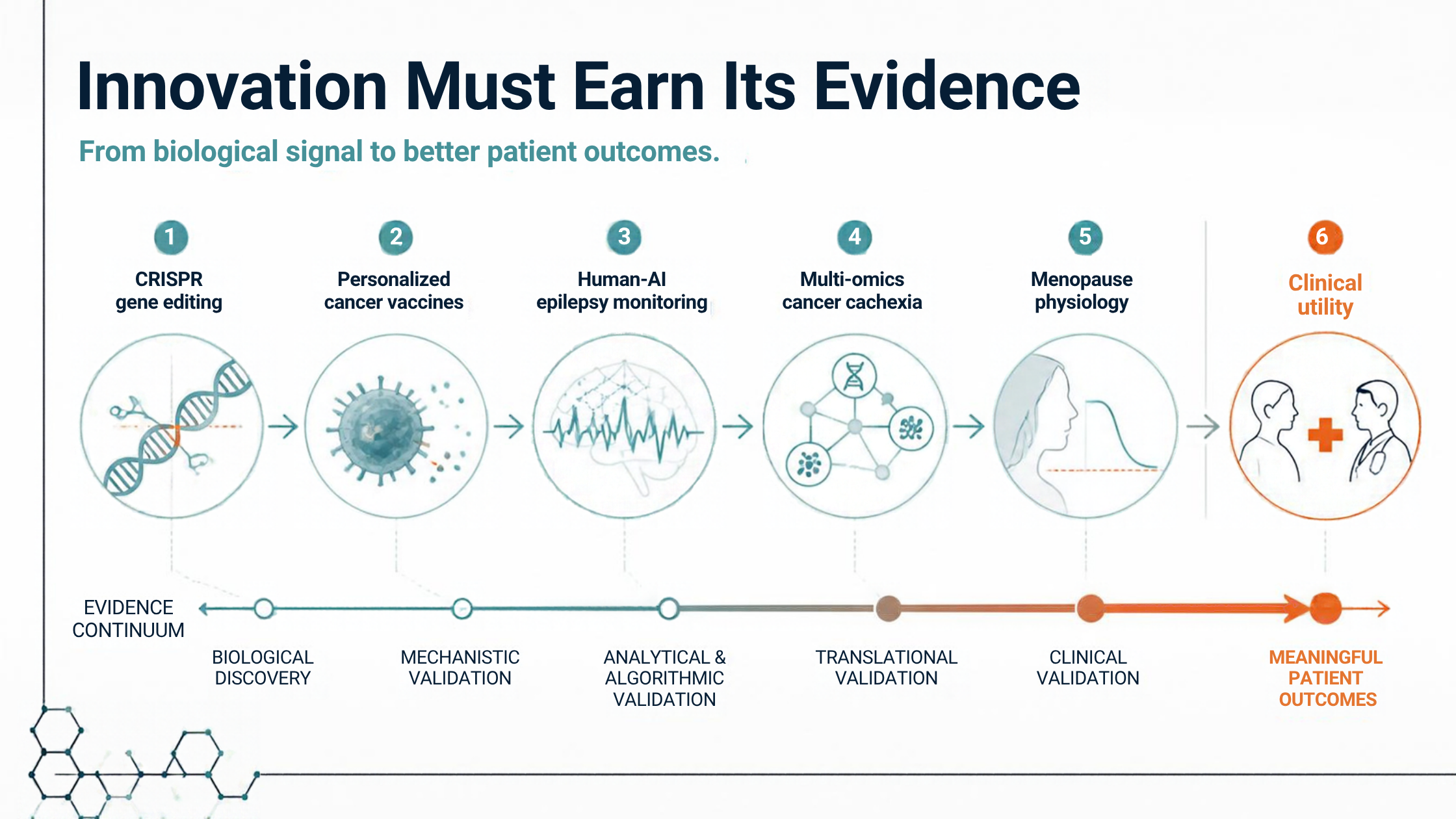
Across these five studies, we see different stages of scientific development.
The CRISPR trial provides randomized clinical evidence of reduced disease activity, while raising important questions about long-term durability and safety.
Personalized cancer vaccines demonstrate biological feasibility and immune activation, but require controlled trials establishing meaningful clinical benefit.
AI-assisted epilepsy monitoring suggests that integrating patient feedback with physiological data may improve detection performance, but requires real-world validation.
Multimodal cancer cachexia research identifies potentially useful biological patterns, yet must demonstrate that predictive models improve care beyond conventional methods.
And large-scale menopause research expands our understanding of systemic physiological changes while highlighting the need for prospective and interventional evidence.
These studies are not equivalent in their level of evidence, and they should not be presented as though they are.
What Should Define the Next Level of Scientific Rigor?
Across precision medicine, we believe six standards are particularly important.
1. Clinical outcomes over surrogate endpoints
Molecular changes, immune activation, and improved algorithmic performance are scientifically informative.
But whenever feasible, clinical research should ultimately evaluate outcomes that matter to patients: survival, disease progression, symptoms, function, safety, and quality of life.
2. Reproducibility beyond the original research setting
Findings should be independently replicated and validated across diverse populations, institutions, and clinical environments.
A result that performs well within a highly controlled research setting may not perform equally well in routine clinical practice.
3. Appropriate controls and causal inference
Randomized controlled trials remain particularly important when determining whether an intervention produces clinical benefit.
Where randomization is impractical or unethical, carefully designed observational and quasi-experimental studies can contribute valuable evidence, provided their limitations are transparently acknowledged.
4. Demonstrated incremental value
New technologies should be evaluated against existing standards of care.
An advanced diagnostic test or multimodal algorithm must demonstrate what additional clinically actionable information it provides beyond established, accessible, and validated methods.
5. Long-term safety and effectiveness
Short-term improvements do not necessarily predict durable benefits.
This is especially important for gene editing, immunotherapies, and other interventions with potentially persistent biological effects.
6. Clinical utility, not technological novelty
The ultimate question is whether an innovation changes clinical decisions in a way that improves outcomes.
More testing, more data, and more complex interventions do not automatically constitute better medicine.
From Scientific Discovery to Clinical Application
Precision medicine is not defined simply by the technologies available to us.
It is defined by how appropriately we apply those technologies to the individual patient.
Genomics, multi-omics, advanced biomarkers, artificial intelligence, and emerging therapeutics are expanding our ability to understand human biology.
Yet the translation from discovery to clinical application requires careful interpretation, appropriate patient selection, rigorous validation, and an understanding of both benefits and limitations.
We should remain enthusiastic about scientific progress without lowering the evidentiary standards required to translate that progress into patient care.
The future of medicine depends not only on what we can do, but on what we can demonstrate is worth doing.
That is the pursuit of precision.
Original Research & References
Genome Editing
Lonvoguran Ziclumeran — In Vivo CRISPR Gene Editing in Hereditary Angioedema. The New England Journal of Medicine, 2026.
https://doi.org/10.1056/NEJMoa2600931Personalized Cancer Immunotherapy
Personalized neoantigen-targeting cancer vaccines in ovarian cancer: a phase 1 trial. Nature Medicine, October 2026.
https://doi.org/10.1038/s41591-026-04717-8Artificial Intelligence and Neurology
Human–artificial intelligence collaboration for comanaging epilepsy in real time. Nature Medicine, October 2026.
https://doi.org/10.1038/s41591-026-04680-4Multi-Omics and Cancer Cachexia
A health-system-scale, episode-resolved multimodal atlas of cancer cachexia. Nature Medicine, October 2026.
https://doi.org/10.1038/s41591-026-04689-9Women’s Health and Menopause
Population-scale reconstruction of menopause dynamics reveals a physiological cliff at the final menstrual period. Nature Medicine, October 2026.
https://doi.org/10.1038/s41591-026-04614-0
About The Pursuit of Precision
The Pursuit of Precision, hosted by Anil Bajnath, MD, explores the science, technologies, and clinical perspectives shaping the future of medicine.
From molecular discovery to clinical implementation, the series examines what emerging research reveals, what remains uncertain, and what it will take to translate scientific progress into meaningful patient outcomes.
Advancing medicine from bench to bedside.
Medical disclaimer: This article is provided for educational and informational purposes only and does not constitute individualized medical advice. Discussion of investigational technologies does not imply regulatory approval, established clinical efficacy, or endorsement for routine clinical use.